
News & events
In this section you will find all the latest news of the Danieli Group. Selecting the categories below, you can see News, Records, Start-ups, New Orders.


corporate information
2026, 27th October
Danieli welcomes steel industry professionals to Udine for the 2026 AIST European Steel Forum
“They say all roads lead to Rome. Today, all steel roads lead to Udine,” said AIST European Member Chapter Chair and GravitHy CEO José Noldin
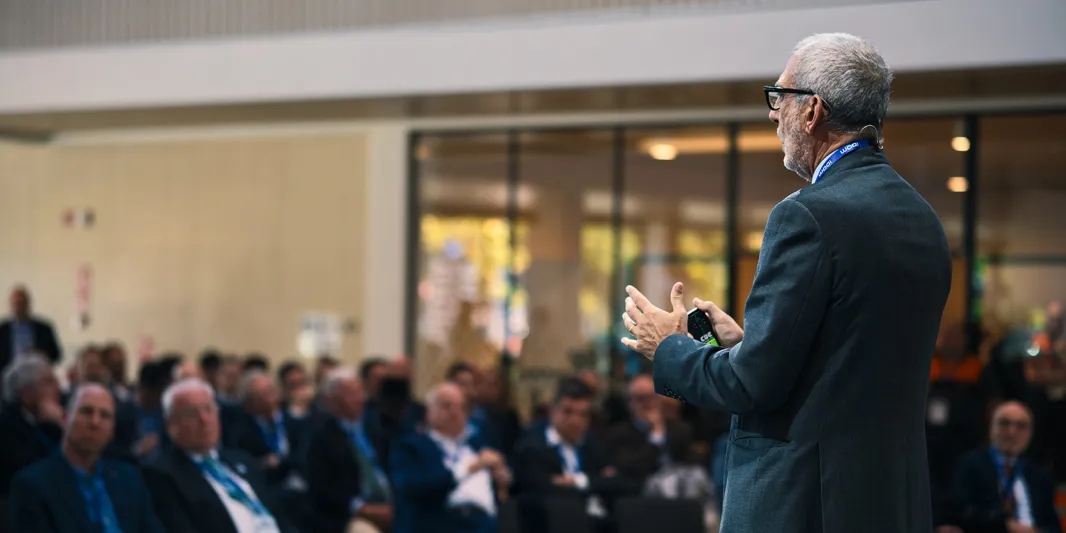
Day one of the European Steel Forum opened at Spazio Villalta, Udine, Italy, with a welcome from Danieli CEO Giacomo Mareschi Danieli and Danieli CEO and CTO Rolando Paolone.
Bringing together steel industry professionals from around the world, the event offered diverse perspectives on some of the most pressing topics shaping the future of European steelmaking.
AIST European Member Chapter Chair and GravitHy CEO José Noldin officially opened the forum: “They say all roads lead to Rome. Today, all steel roads lead to Udine.”
His welcome was followed by AIST Executive Director Ronald Ashburn’s opening speech, “Steel’s Age of Realignment,” which set the stage for the day's discussions. Change, emerging technologies and artificial intelligence were addressed alongside the uncertainties currently affecting the industry, from energy costs and availability to the risk of deindustrialization and changing global trade dynamics.
With growing pressure on European steelmakers, the discussion highlighted the importance of effective trade protection while maintaining industrial competitiveness. Energy also emerged as a central theme, particularly against the backdrop of growing electricity demand driven by digitalization and AI: steel needs energy, and energy needs steel.
A pragmatic path toward carbon neutrality
The first panel, “Transformation of the European Steel Industry for Carbon Neutrality,” moderated by Jürgen Cappel, Managing Director of Cappel Stahl Consulting GmbH, brought together Andrea Bianchi, Chief Technical Officer, Arvedi Group; Thomas Bürgler, Chief Executive Officer, K-1 Met; Martin Pei, Senior Advisor, SSAB AB; Sebastian Börner, Technical Project Manager, Power4Steel, Stahl-Holding-Saar; and Soeke Helmers, Lead EAF, Salzgitter Flachstahl GmbH.
The discussion explored the progress of Europe’s steel transformation and the challenges that remain on the road to lower CO₂ emissions.
Across the different projects and perspectives presented, pragmatism emerged as a recurring theme. Panelists discussed the need to maintain and enhance product quality while addressing European constraints surrounding energy availability, infrastructure, raw materials and the realistic adoption of hydrogen.
The availability and quality of raw materials, particularly scrap, were also highlighted as increasingly important factors for future steelmaking operations. Overall, the discussion pointed to a transition that is moving forward, although potentially over a longer timeframe than originally envisioned, and underlined the importance of a supportive European policy framework.
European steel at a crossroads
Following the networking break, Antonio Marcegaglia, Chairman and Chief Executive Officer of Marcegaglia, delivered the keynote presentation “European Steel at a Crossroads.”
His presentation reinforced several themes raised during the opening panel, including declining European steel production, stagnating demand, pressure from imports and the need to preserve the competitiveness of European manufacturing.
The message was clear: decarbonization must not become deindustrialization.
A pragmatic, step-by-step approach combining clear policy, appropriate trade measures, competitive energy and realistic transition technologies will be essential to achieving Europe’s decarbonization goals while maintaining its industrial base. The presentation concluded with a focus on Marcegaglia’s ongoing Fos-sur-Mer project.
Looking beyond steel: the energy challenge
The afternoon continued with “Carbon-Free Energy Sources for the European Industry,” moderated by Susanne Michelic, Chair of Ferrous Metallurgy at Montanuniversität Leoben.
The panel brought together perspectives from steel, lime, cement and energy, with Alexander Fleischanderl, Chief Technology Officer and Head of Green Steel, Primetals Technologies Austria GmbH; Gabriele Imparato, Chief Executive Officer, Unicalce SpA; Lutz Weber, Managing Director, Alpacem; Gabriele Guastaferro, Process Engineer, Danieli Green Metal; and Christian Koulic, Global Market Executive Metals, TotalEnergies.
Despite the differences among the industries represented, several common challenges emerged. Affordable and reliable energy, suitable infrastructure and supportive policy frameworks are essential to turn decarbonization technologies into viable industrial solutions.
For Danieli, Gabriele Guastaferro highlighted the role of energy efficiency and heat recovery technologies, including Q-STEAM, CHR Clean Heat Recovery and THERMACOMP. He also addressed ENERGIRON, the direct reduction technology jointly developed by Tenova and Danieli, and the opportunities offered by hydrogen-ready solutions and electrification.
The wider discussion returned to the balance between affordability, reliability and sustainability, while acknowledging that different industries will require different pathways toward decarbonization.
The day closed on a note of cautious optimism. Timelines may be evolving and significant challenges remain, but the direction is clear: Europe’s industrial transition is underway, and cooperation across technology, energy, industry and policy will be essential to move it forward.
Rethinking where and how iron will be made
The final panel of the day,“Where and How Will Iron Be Made? Rethinking Feedstock and Geography in a Decarbonizing Steel Industry,” shifted the focus to another fundamental question for the future of steelmaking: where will iron be produced, and from which raw materials?
Moderated by Felix Firsbach, Vice President, Badische Stahl-Engineering GmbH, the panel brought together Neeraj Singh, Plant Head, Jindal Steel Duqm; Naota Furihata, General Manager Low Carbon Metallics Department, Iron Ore Division, Mitsui & Co., Ltd.; Thomas Brown, Head of Business Development and Commercial Strategy, Binding Solutions Ltd.; Thiago Campos, Head of Green Steel, SMS group Inc.; and Jan Eisbacher-Lubensky, Chair of Ferrous Metallurgy, Montanuniversität Leoben.
As decarbonization reshapes traditional steelmaking routes, the discussion explored the changing relationship between energy, geography and raw materials, including the potential decoupling of ironmaking from steelmaking. Attention also turned to the evolving role of scrap, alternative feedstocks and merchant metallics such as pig iron and hot-briquetted iron, and how these developments could reshape global supply chains.
The discussion provided a fitting conclusion to a day in which one message repeatedly emerged: the transformation of the steel industry will not depend on technology alone, but on bringing together competitive energy, available raw materials, infrastructure, investment and pragmatic policy.
Following a full day of discussions, the European Steel Forum continued with an evening of networking and music, bringing the first day in Udine to a close.


